Pulsar Dispersion-Measure Variations with CHIME
High-cadence CHIME observations make it possible to study dispersion-measure variations on timescales that are difficult to resolve with conventional pulsar-timing observations.
Overview
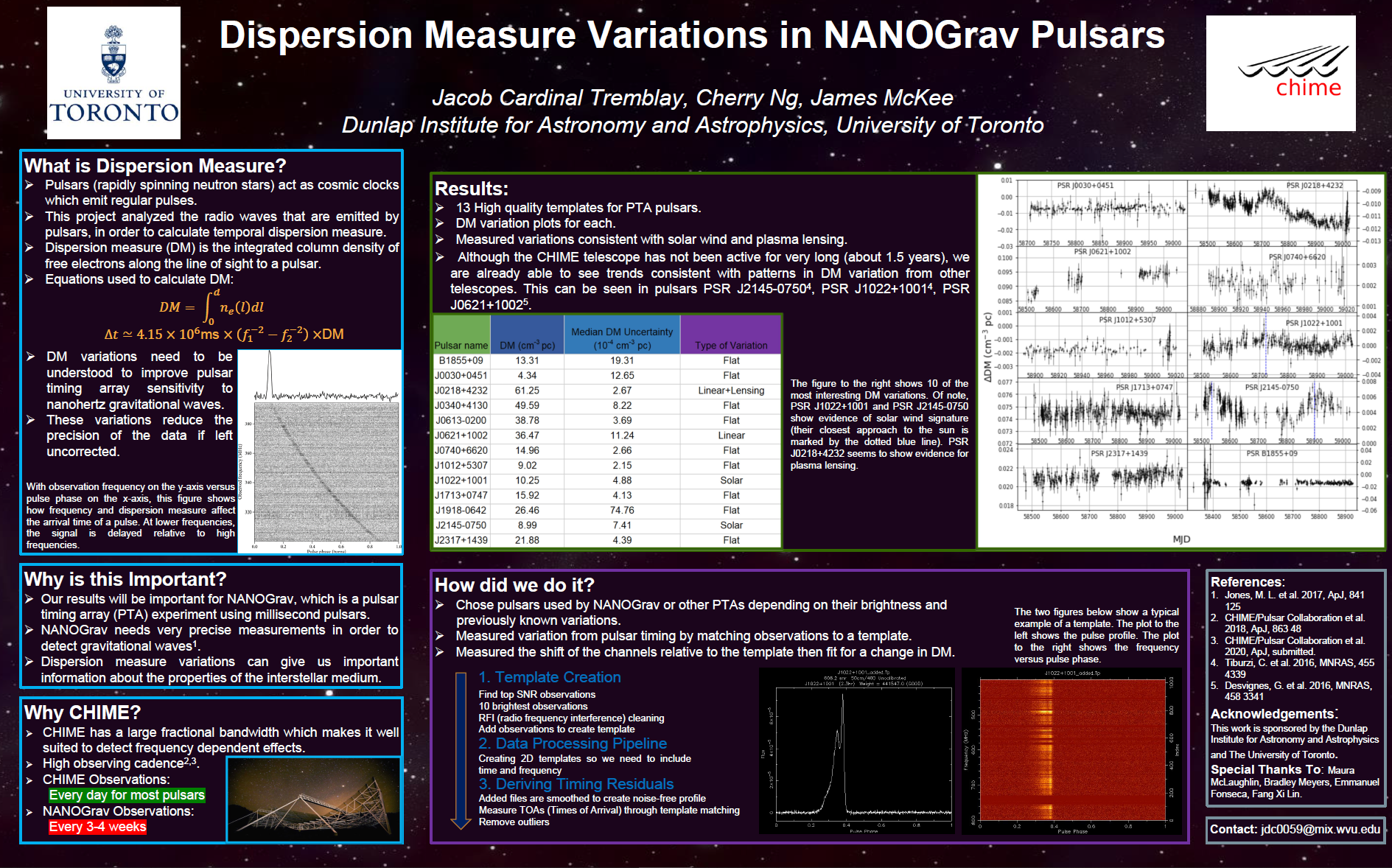
This project was completed through the Undergraduate Summer Research Program at the University of Toronto under the supervision of Cherry Ng and James McKee. I used the Canadian Hydrogen Intensity Mapping Experiment (CHIME) to evaluate trends in the dispersion measure (DM) of pulsars used in pulsar timing arrays, many of which were part of the NANOGrav data set.
Dispersion measure describes the integrated free-electron content between a pulsar and Earth. Changes in that material can alter pulse arrival times and contaminate the data used in gravitational-wave analyses. Variations can arise when a sightline passes close to the Sun or when structures such as gas or plasma clouds move across it.
CHIME can observe a pulsar every day, compared with the multi-week cadence common in many timing programmes. That daily coverage is particularly valuable because some DM events evolve over days or weeks. We measured detailed variations from 13 pulsars, including two with solar-related changes and one with trends consistent with plasma lensing.