
Observational Astronomy Projects
Four observational-astronomy projects completed in 2021 introduced me to radio, X-ray, infrared, and visible-light data, from calibrated imaging to catalogue and spectral analysis.
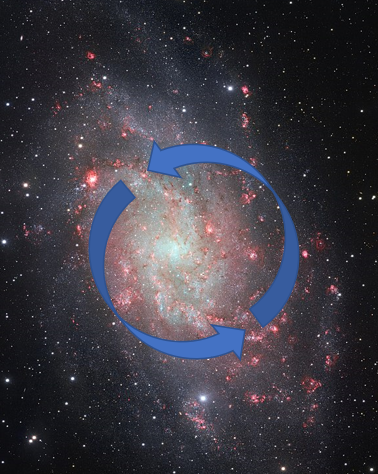
Mapping neutral hydrogen in M33
The data were used to investigate the motion of M33 and the structure of its neutral-hydrogen emission. From the observed velocity pattern, we inferred that the galaxy rotates counter-clockwise relative to the observing position while its systemic motion is toward the observer.
The analysis also produced an estimated mass of approximately 1011 solar masses. Moment maps were used to interpret the spatial and velocity structure of the three-dimensional data cube.
Project report
Additional observational studies
X-ray analysis of the Vela Pulsar
Archival Chandra observations were separated into soft- and hard-X-ray bands to compare their spectra and spatial distributions and to investigate the physical mechanisms behind the emission. Explore the Vela Pulsar analysis →
Exploring the 2MASS catalogue
Infrared point-source measurements were used to identify a population separated from the main stellar sequence in a colour-colour diagram and evaluate its possible physical interpretation. Explore the 2MASS catalogue analysis →
Imaging the Orion Nebula
Visible-light observations from the White Hall Telescope were calibrated to reduce instrumental noise and compare wavelength-dependent structure in the nebula. Explore the Orion imaging project →