Machine Learning for RFI Mitigation
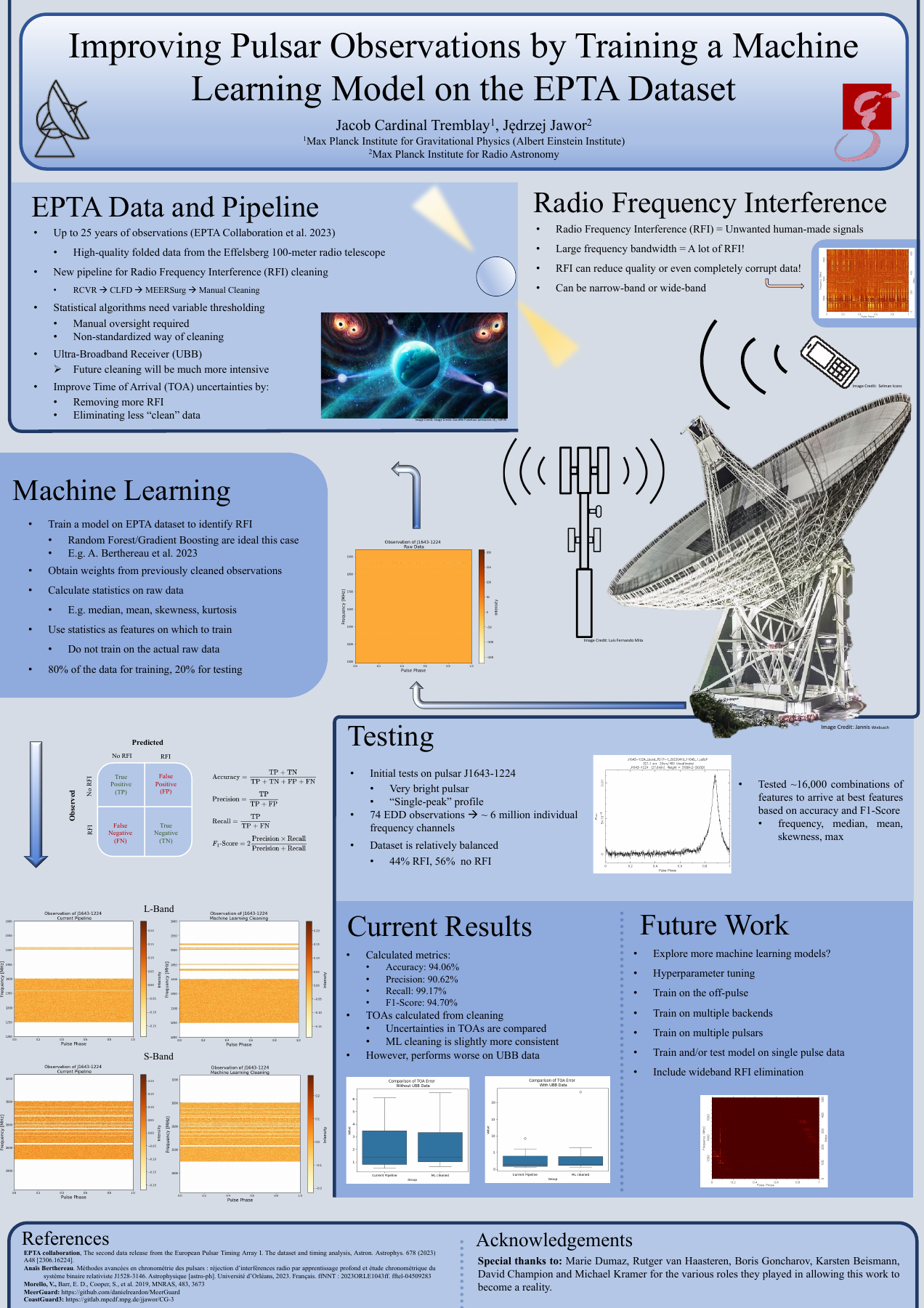
In this ongoing side project with Jędrzej Jawor, I am investigating whether machine-learning classifiers can identify radio-frequency interference from summary statistics and raw pulsar data. We aim to produce a machine learning model which can outperform current RFI mitigation algorithms.
From channel statistics to cleaner observations
The current classifier was evaluated on 74 Effelsberg observations of PSR J1643−1224, spanning roughly six million frequency channels. On this test set, it reached 94.06% accuracy, 90.62% precision, 99.17% recall, and an F1 score of 94.70%.
Initial timing tests are slightly more consistent after automated cleaning. The model does not yet generalise equally well to every backend—particularly ultra-broadband data—so the next steps include hyperparameter optimisation, alternative classifiers, and training across more pulsars and observing systems.